
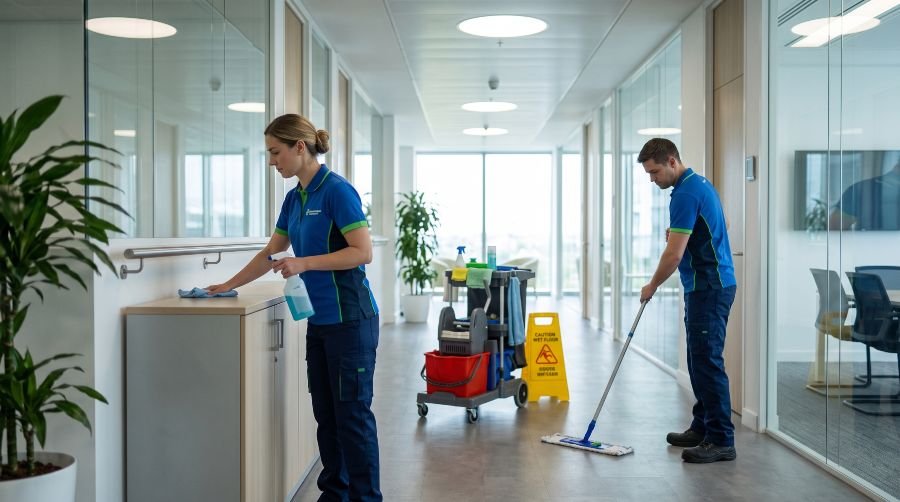
When you hire a cleaning company, you are paying for more than someone to empty the trash. You are paying for a set of responsibilities that keep your space hygienic, safe and ready for work every morning. The problem is that those responsibilities are often left vague. The contract says “office cleaning,” and everyone assumes the other side knows what that includes.
Understanding janitorial duties in detail helps you set clear expectations, spot gaps before they turn into complaints and compare providers on what they actually deliver. Here is what a professional cleaning team should be doing, and what usually falls outside the standard scope.
What “janitorial” really means
Janitorial work is the routine, recurring care of a building. It is different from one-time deep cleaning or specialized services like carpet extraction. Think of it as maintenance cleaning: the tasks that happen every visit to keep a space in good condition, so it never gets to the point where it needs a major intervention.
That routine usually happens after hours in offices and before opening or after closing in retail. Some buildings also add a day porter, a team member on site during business hours who handles restrooms, spills and restocking while people are working.
Core daily duties
Trash and recycling
Emptying bins sounds simple, but it is one of the most visible jobs. A good team empties every container, replaces liners, wipes the bins when they get dirty and sorts waste into the right streams. In San Francisco, that means separating recycling, compost and landfill correctly.
Restroom care
Restrooms are where standards are judged most harshly. Daily duties include cleaning and disinfecting toilets, urinals, sinks and counters, cleaning mirrors, wiping partitions and touchpoints, mopping floors and keeping dispensers full. If restrooms are wrong, nothing else the team does will be noticed.
Surface cleaning and disinfection
Desks, counters, conference tables and reception areas need regular dusting and wiping. High-touch points, such as door handles, light switches, elevator buttons and shared equipment, should be disinfected on every visit. One detail to agree on in advance: whether the team cleans desks with papers or personal items on them, or only clear surfaces.
Floor care
Vacuuming carpets, sweeping and mopping hard floors and spot-cleaning spills are standard daily duties. Entry mats deserve attention too, since they stop much of the dirt that would otherwise spread through the building.
Kitchens and break rooms
Counters, sinks, tables and the outside of appliances should be cleaned every visit. Some contracts include loading the dishwasher or cleaning the inside of the microwave; others leave those to staff. Make sure everyone knows which version you have.
Restocking supplies
Toilet paper, paper towels, hand soap, sanitizer and trash liners should be checked and refilled on every visit. Running out of essentials is one of the most common sources of complaints, and it is entirely preventable.
Periodic duties
Beyond the daily routine, a solid janitorial plan includes tasks done weekly or monthly. These typically cover dusting baseboards, blinds and vents, cleaning interior glass and partitions, wiping down chairs, detailing restroom grout and edges and cleaning out the refrigerator on an agreed schedule.
These tasks are easy to skip because nobody notices them for a few weeks. That is exactly why they should be written into the scope with a set frequency.
The duties people forget: eyes and ears
A cleaning crew walks every corner of your building, often when no one else is there. That makes them an early warning system. A professional team reports leaking faucets, running toilets, broken fixtures, burnt-out lights and damaged flooring before they become bigger problems.
Security is part of the job as well. Teams working after hours should follow your procedures for doors, alarms and keys, and lock up exactly as they found the space. Safety matters too: wet floor signs, proper chemical handling and keeping walkways clear protect both the crew and your staff.
What is usually outside standard janitorial duties
Some services are typically quoted separately because they need special equipment, more time or a different schedule. Carpet shampooing or extraction, floor stripping, waxing and buffing, high or exterior window cleaning, post-construction cleanup and full deep cleaning usually fall into this category.
There are also things a cleaning team should generally not handle: sorting confidential documents, moving heavy furniture without notice, cleaning inside IT equipment or dealing with hazardous materials outside normal cleaning products. Agreeing on these limits upfront prevents awkward misunderstandings later.
Turn duties into a written scope of work
The clearest way to protect yourself is a written scope of work. List each area of your space, the tasks for that area and how often each is performed. Include what is excluded, how supplies are handled, who your contact is and how issues are reported and fixed.
A detailed scope makes it easier to compare quotes, onboard a new provider and hold everyone to the same standard over time.
Signs your cleaning team is skipping duties
Watch for small signals. Dust on baseboards or vents, overflowing bins in the morning, empty soap dispensers, sticky kitchen counters or the same stain sitting on the carpet for weeks all suggest that parts of the routine are being dropped. If your team keeps mentioning the same issues, the problem is usually supervision, not effort.
Get a cleaning team that does the whole job
You shouldn’t have to chase your cleaning crew to get what you are paying for. Our recurring cleaning service is built on a clear task list for every area of your space, delivered on a daily, weekly or monthly schedule.
If you run an office, store or clinic in San Francisco, talk to our team and we’ll help you define exactly what your cleaning plan should include.